Category: Uncategorized

Birds in Belarus, video
This April 2015 video is about birds in Belarus: black grouse, northern lapwing and Eurasian sparrowhawk.
Weeds, Invasives and Books Part 2


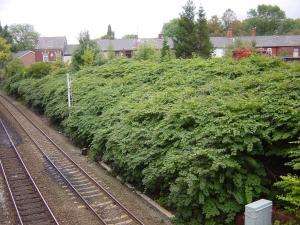
Sometime beyond 30,000 years ago the climate had changed, and the cold and ice advanced out of the arctic covering a large portions of North America, Europe, and Asia. The ice sheet was estimated to be a mile thick and with so much of the water of this planet frozen, the oceans were as much as 450 feet lower than they are today. As the ice sheet advanced to cover what we now call home, it had scraped and scoured the earth carrying soil particles, boulders and anything living in its’ path that couldn’t flee its’ approach. The areas south of the major ice sheets were what might be considered sub-arctic; a tundra and open boreal woodland with very little rain. Around 13,500 to 11,000 years ago the ice sheets receded and the flora that had managed to survive south started to advance north and grow in bare mineral…
View original post 1,411 more words
Birdwatching in Kenya, video
This 20 November 2018 video says about itself:
Kenya is full of amazing wildlife—giraffes and elephants, ostriches and hornbills. Cornell senior Sarah Toner visited last spring to film and record the abundant wildlife, and to witness field research in progress. Sarah first came to Cornell as part of our Young Birders Event in 2013.
HUMAN POPULATION GROWTH AND CLIMATE CHANGE

The largest single threat to the ecology and biodiversity of the planet in the decades to come will be global climate disruption due to the buildup of human-generated greenhouse gases in the atmosphere. People around the world are beginning to address the problem by reducing their carbon footprint through less consumption and better technology. But unsustainable human population growth can overwhelm those efforts, leading us to conclude that we not only need smaller footprints, but fewer feet.
Portland, Oregon, for example, decreased its combined per-capita residential energy and car driving carbon footprint by 5 percent between 2000 and 2005. During this same period, however, its population grew by 8 percent.
A 2009 study of the relationship between population growth and global warming determined that the “carbon legacy” of just one child can produce 20 times more greenhouse gas than a person will save by driving a high-mileage car, recycling…
View original post 711 more words
One Acorn

“The creation of a thousand forests is in one acorn”
― Ralph Waldo Emerson

And just look at the magnificence one acorn produces!
I can’t even tell you how absolutely amazing this oak tree was, I wish so much that I could have captured a better quality photo of it. Even so, a camera image will never match the real thing. This tree was HUGE, and its rich, vibrant, reddish-orange color just screamed for attention, it stood out so much from all the rest! I don’t usually think much of an oak tree’s autumn colors, but this year they all really seemed to catch my attention, especially this one! Maybe the weather we’ve had affected them, but I swear their colors were much more vivid this year.
My daughter and I were out together the day I came across it, and I snapped this photo of her sitting in…
View original post 65 more words
Macron kills waders, bird lovers angry
This video from Britain says about itself:
17 August 2016
Godwits are large, elegant waders and relatively common in the right habitats at certain times of year. The two commonly encountered species, Black-tailed and Bar-tailed Godwit, should be reasonably straightforward to separate, although their eponymous tail markings may not always be the easiest feature to use! Some birds such as juveniles or out of context lone birds can prove more problematic, however, and this workshop will help you to confidently identify both species.
Translated from Dutch NPO radio today:
Conservationists angry with France about shooting of shorebirds
Nature organizations in the Netherlands and Belgium are angry about the decision of the French government to extend the hunting ban on the godwit with only one year, until 2020. This means that from then on it will be possible again to shoot godwits. “And to think that a lot…
View original post 517 more words
News from The Treetalker
Ice Age American elephants
This video says about itself:
15 June 2017
The proboscideans are a group of animals that contains the elephant and mastodont families. Many of us will be well-aware of these groups, but what of some of the lesser-known proboscideans? One such family are the gomphotheres and in this episode we’re introduced to them by Dr Dimila Mothé, of the Federal University of the State of Rio de Janeiro, Brazil.
By Alexandra Witze in the USA, 12:30pm, November 13, 2018:
How mammoths competed with other animals and lost
Human hunters helped wipe out mammoths, mastodons and gomphotheres
The Gray Fossil Site, a sinkhole in northeastern Tennessee, is full of prehistoric treasures. Between 7 million and 4.5 million years ago, rhinoceroses, saber-toothed cats and other creatures, even red pandas, perished here by the edge of a pond. But that bounty of fossils pales next to the site’s biggest find: a
View original post 442 more words
Which animals hibernate? Video
This 9 November 2018 video says about itself:
Which Animals Hibernate?
When it comes to hibernating, mammals, reptiles, and amphibians are fair game for this long rest.
 Wild Voices