
By Sharon St Joan
To read part one first, click here.
Are wild horses native?
While it is generally assumed that wild horses are descended from the horses that the Spanish conquistadors left behind in the Sixteenth Century, there is considerable evidence that the native wild horses of the west may never have died out at all and may always have been present on this land.
Craig Downer in his remarkable book The Wild Horse Conspiracy details twenty separate examples of fossilized remains of wild horses scientifically dated to between 700 years before the present to 7,000 years before the present. All these fossils appear on this continent during the thousands of years during which wild horses were believed to have been absent from the Americas.
Craig Downer also gives a fascinating account of the ways in which the presence of wild horses benefits the land. Contrary to the picture that is often presented, they consume coarser, drier vegetation, which allows many kinds of grasses and other vegetation to thrive, creating greater biodiversity and a healthier eco-system.
Whether they have always lived here, without interruption, may be debated, but two things are not open to debate: No one disputes the fact that all horses originated in the Americas. North and South America are the only homeland of the horse – all the horses on earth trace their ancestry back to the Americas. Whether they were here, then gone for a time – just a blip on the geological time scale, of a few thousand years – or whether they never left at all and have always been right here, the indisputable fact remains that they have no other home. This is their original native land. They are American wild horses.
Secondly, native or not, there is no excuse for the inhumane and brutal treatment to which wild horses are being subjected.
All animals should be treated humanely.
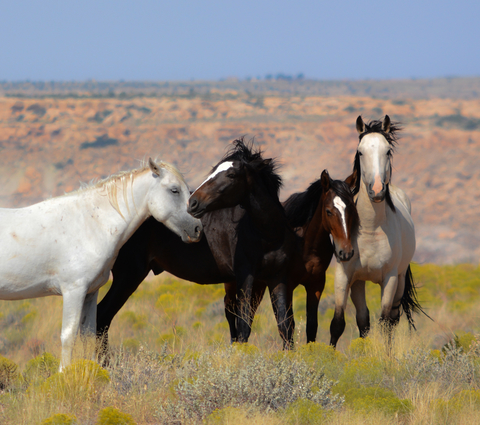
We are not talking here about private land, but about both state and public land. Do we want the wild horses whose native home is our western wild lands to be sacrificed to business and industry? We must leave the wild lands and the wild animals that live there free to live and be wild. The world of nature is not something to be used up as fast as possible. If we do that, in the end we will all be left with nothing, only a ruined wasteland. Instead, let us open our eyes. Let us value and be grateful for the God-given blessing of being able to live in a land of immense beauty among innocent, majestic animals.
Who would not be moved by the soaring beauty of wild horses running in joy, their manes flying in the wind?
Wild horses, like all sentient beings, have a soul and a spirit. We need to drop our human concerns for a moment of silence and listen to the voices of the wild – to the soul of wild America.
Our fellow beings on the earth are our brothers and sisters; we are all interconnected; we are all children of the earth.
Can we stand by idly while those around us destroy the natural world – failing to speak up for it, or to protect it, or to value its beauty and its sacred essence?
Wild horses cannot speak up for themselves. It is up to us to take the time and show the willingness and the courage to speak up behalf of these innocent wild beings. Then, whatever the outcome, we will have done our best.
Links:
BLM press release requesting comments before May 20, 20:
BLM oil and gas leasing proposal for the San Rafael Swell – Scroll down to the San Rafael Desert Master Leasing Plan:
https://www.blm.gov/programs/planning-and-nepa/plans-in-development/utah
The Wild Free-Roaming Horses and Burros act of 1971
https://www.blm.gov/or/regulations/files/whbact_1971.pdf
Salt Lake Tribune on BLM’s plan for wild horses:
House of Representatives and BLM proposal:
YouTube video about wild horses:
https://www.youtube.com/watch?v=O26lZ0nX30U&feature=share
Craig C. Downer’s book, The Wild Horse Conspiracy, is available on Amazon.
Photo credits, part two:
First photo:
ID 22302503 © Matthew Ragen / Dreamstime.com, in the Ochoc mountains of Central Oregon.
Second photo:
ID 99529976 © Lynnbellphoto / Dreamstime.com, the Ute Reservation


 Wild Voices