Author: sharonstjoan
Poet, writer, and advocate for wildlife, wild lands, and the earth. President, Forest Voices of India - a U.S.-based group which aids charities in India that further education, culture, the well-being of women, children, and animals, and the restoration of sacred groves.
websites:
https://wordpress.com/view/forestvoicesofindia.com
https://wordpress.com/view/echoesinthemist.com
https://wordpress.com/view/wildvoices.world
book: Glimpses of Kanchi
https://www.amazon.com/Glimpses-Kanchi-Sharon-St-Joan/dp/1982901179/ref=sr_1_1?keywords=Glimpses+of+Kanchi&qid=1581769003&sr=8-1

Eurasian lynx in Sweden, video
The most extreme life on the planet. Part one: life in volcanos.


For all its beauty, Yellowstone National Park is a terrifying place. If it erupted tomorrow, most of America would be drowned in ash, and they wouldn’t see sunlight for weeks. Add extreme pressures, no nutrients and oxygen depletion to the searing heat in volcanic pools and you can understand why we used to think life here was impossible.
However, those amazing dashes of red, green and yellows sweeping across the volcanic pools are not from the rocks but from microbial life which aren’t just tolerating the scorching heat, but need it to survive.
Apart from being a liiitle bit painful, if I jumped in the pool and tried to survive, my cell membranes would crumble, my enzymes and proteins would melt and my DNA simply unravel and fall apart. How is it then, that at 115°C we…
View original post 198 more words
US Congressional Testimony of Benjamin Nuvamsa, Elder of the Hopi Bear Clan, on Importance of the Grizzly Bear


Yellowstone National Park Grizzly sow and cubs
“Mr. Benjamin H. Nuvamsa (testimony)
Hopi Bear Clan
Former Chairman, Hopi Tribe
Village of Shungopavi, AZ
Testimony of Benjamin Nuvamsa
Tribal Heritage and Grizzly Bear Protection Act (H.R. 2432)
Subcommittee on Water, Oceans and Wildlife
May 15, 2019
Mr. Chairman and Honorable Members of the Subcommittee on Water, Oceans, and Wildlife. My name is Benjamin H. Nuvamsa. I am a member of the Hopi Tribe of Arizona; and a member of the Hopi Bear Clan of the Village of Shungopavi, on Second Mesa. I am also former Chairman of the Hopi Tribe.
I am honored and humbled to come before you today as an elder of the Hopi Bear Clan; and as a practitioner of our traditional ceremonies, to explain the importance of the Grizzly Bear to the culture, traditions, and the lifeways of the Native people of the United States and…
View original post 600 more words
Extinct species of bird came back from the dead, scientists find

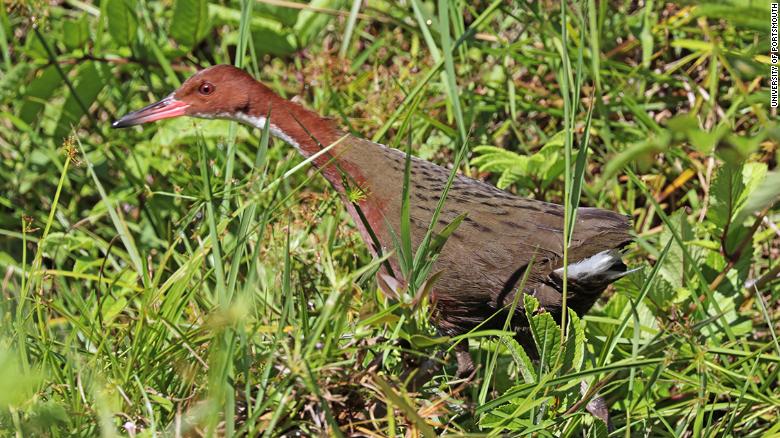
The white-throated rail colonized the Aldabra Atoll in the Indian Ocean — twice.
(CNN)A previously extinct species of bird returned from the dead, reclaiming the island it previously lived on and re-evolving itself back into existence, scientists have said.
The white-throated rail colonized the Aldabra Atoll in the Indian Ocean and evolved to become flightless, before being completely wiped out when the island disappeared below the sea around 136,000 years ago.
But researchers found similar fossils from before and after that event, showing that the chicken-sized bird re-appeared when sea levels fell again a few thousand years later, re-colonized the island and again lost the ability to fly.
The flightless rail can be found on Aldabra to this day.
The extremely rare process is known as iterative evolution — the repeated evolution of a…
View original post 451 more words
Becoming


News from The Treetalker


 Courtesy WhatWhenHow.com
Why large forest fires may not be a big threat to some endangered animals, January 29, 2019, ScienceDaily. Source: Oxford University Press USA
Spurred by climate change, megafires in western North America are becoming more frequent, causing speculation that endangered species will have an even more difficult surviving.
The Great Gray Owl, endangered in California, is a resident of Yosemite National Park and Stanislaus National Forest, which are areas that were badly burnt in the 2013 Rim Fire, experiencing a 104,000 acre burn.
In surveys covering a 3-year period following the fire, it was found that, rather than decreasing in number, the Grey Owls have adjusted to the terrain well, using large trees that were killed for nesting, and finding plentiful food in the rodent populations that have increased, due to more meadow area. Read the rest of the article here.
 Neil Palmer:CIAT
Cattle urine’s planet-warming…
View original post 819 more words
Blue-throated piping guan in Brazil, video
Earth Day Hero: Rachel Carson

 Rachel Carson. Photo from Rachel Carson The Writer at Work by Paul Brooks.
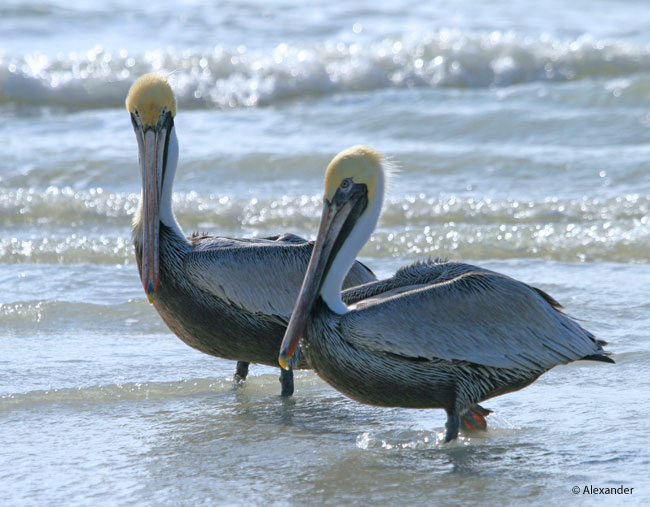 Pair of Brown Pelicans, Ding Darling National Wildlife Refuge, FL
Rachel Carson changed the world when her book, Silent Spring, was published in 1962. At the time of writing, agriculture was accelerating to new heights with the advancement of synthetic fertilizers, insecticides, and pesticides.
The pesticide DDT had been heralded during WWII for controlling malaria, typhus, body lice, and bubonic plague; Paul Herman Muller had been awarded a Nobel prize for it.
From the 1950s on, DDT (dichloro-diphenyl-trichloro-ethane) was used extensively–40,000 tons a year, worldwide. Especially effective in eliminating mosquitoes, it was liberally sprayed from airplanes and trucks, on crops and neighborhoods.
Insect-borne diseases, they said, would be a thing of the past.
 Mosquito control, Jones Beach State Park, Long Island, 1945. The sign says “DDT, Powerful Insecticide, Harmless to Humans.” Bettmann/Corbis
As a child in the…
View original post 545 more words
Water, Not Temperature, Limits Global Forest Growth As Climate Warms

ScienceDaily reports
The growth of forest trees all over the world is becoming more water-limited as the climate warms. The effect is most evident in northern climates and at high altitudes where the primary limitation on tree growth had been cold temperatures. The research details the first time that changes in tree growth in response to current climate changes have been mapped at a near-global scale.
Read story at Water, not temperature, limits global forest growth as climate warms — ScienceDaily
 Wild Voices