Save The Frogs Day April 28, 2018

Sandy Steinman's avatarNatural History Wanderings

In an effort to raise awareness of the plight of amphibians, the scientific community has declared Saturday April 28th, 2019  ‘Save The Frogs Day’. On this day we encourage the appreciation and celebration of amphibians by people from all walks of life. Only a small proportion of the public is aware that frogs are disappearing, and amphibian conservation efforts will not be successful with an un-informed public. Our goal is to make the amphibian extinction crisis common knowledge, and Save The Frogs Day is our best way to make this happen!

To learn more and find local events go to: Save The Frogs Day

View original post

Saving forest elephants saves forests

petrel41's avatarDear Kitty. Some blog

This 2013 video says about itself:

The Dzanga Bai, a small clearing in the Central African Republic, is a unique haven for endangered forest elephants. As many as 200 at a time will gather in this open area to eat minerals found in the soil. The Bai is part of the protected Dzanga-Ndoki National Park, but poachers recently entered the park killing more than two dozen elephants. This video shows elephants enjoying the Bai and reveals efforts to again make it a safe haven for the African forest elephant, a species whose numbers have been reduced by more than 60% in the past decade.

From the Carl R. Woese Institute for Genomic Biology, University of Illinois at Urbana-Champaign in the USA:

Protect forest elephants to conserve ecosystems, not DNA

April 25, 2018

Although it is erroneously treated as a subspecies, the dwindling African forest elephant is…

View original post 506 more words

Global Problems, Forests & Solutions

Organikos's avatarOrganikos

19lovejoy-reid-jumbo.jpg

Thomas E. Lovejoy a pioneer in the use of economics to conserve forests and other ecosystems globally is joined by John Reid, who has worked in the Amazon since 1965, in presenting a case for:

How Big Forests Solve Global Problems

Sit on a log by the Madidi River in Bolivia at dusk and you can hear what an Amazon forest should sound like. The music includes red howler monkeys, breathy thumps from the mutum jungle fowl, droning cicadas, eerie calls locals attribute to deadly bushmaster vipers and the unhinged excitement of elusive titi monkeys. Around your feet, the beach is crisscrossed by jaguar tracks and those of the pony-size tapir, a shy beast that, if you keep quiet, will saunter out of the forest and swim across the river.

This is what scientists call an “intact forest landscape.” It’s a swath of at least 500 square kilometers (about…

View original post 538 more words

Petition · Bureau of Land Management: Prevent Oil and Gas Drilling Near The Great Sand Dunes National Park · Change.org

Nancy's avatar"OUR WORLD"

Prevent Oil and Gas Drilling Near The Great Sand Dunes National Park
Brendan Monogue started this petition to Governor John Hickenlooper and 4 others

The Great Sand Dunes of Colorado are some of the most unexpected and glorious natural features in the West. Protected within a 150,000 acre national park, the sand dunes roll and swerve in fantastic changing patterns and are visited by hundreds of thousands of tourists every year.

Now this incredible park is under attack. The Bureau of Land Management (BLM) is planning to auction off the mineral rights of thousands of acres of land just outside the park to the oil and gas industry.

Please sign our petition to protect this natural wonder from a greedy, and destructive industry.

Oil and gas developments can contaminate our water and air, destroy native plants, and harm or displace wildlife — all of which are crucial to this fragile…

View original post 119 more words

BLM seeks public comment of Environmental Analysis for Wild Horse Gather in Southeastern Utah

R.T. Fitch's avatarStraight from the Horse's Heart

News Release

Utah State Office

FOR IMMEDIATE RELEASE:

April 20, 2018

Media Contact: Lisa Reid  (435) 743-3128

BLM seeks public comment of Environmental Analysis for Wild Horse Gather in Southeastern Utah

Price, Utah—The Bureau of Land Management (BLM) Price Field Office is seeking public comment on an environmental assessment (EA) analyzing a proposed wild horse gather, removal and fertility treatment in the Muddy Creek Herd Management Area (HMA).

The Muddy Creek HMA is located in Emery County, approximately 20 miles south of Ferron, Utah, in the San Rafael Swell. It consists of approximately 283,400 acres of public and state lands.

The EA analyzes a proposal to gather and remove excess wild horses and apply fertility control between two and four times over a ten-year period. The EA, including maps, is available on ePlanning at: https://eplanning.blm.gov/epl-front- office/eplanning/nepa/nepa_register.do; search for project name “Muddy.”

Written comments will be accepted by letter or…

View original post 233 more words

The Pinsapos of Sierra Bermeja – A Refuge for the Rare Fir Trees

The Pinsapos of Sierra Bermeja – A Refuge for the Rare Fir Trees

Nick Rowan's avatarThe Treeographer

Pinsapos, or Spanish Fir trees, are exceptionally rare. They are found in just a few mountain ranges in Andalusia and Morocco, with the largest pinsapo forest located in the volcanic soil of Sierra Bermeja. It was here that the trees were first introduced to the world of science in 1837, and today it remains one of the best places to visit these spectacular trees.

View original post 748 more words

Dinosaur age sea turtle discovery in Alabama, USA

petrel41's avatarDear Kitty. Some blog

This is a reconstruction of the new species (Peritresius martini). Credit: Drew Gentry CC-BY

From PLOS:

New ancestor of modern sea turtles found in Alabama

April 18, 2018

A sea turtle discovered in Alabama is a new species from the Late Cretaceous epoch, according to a study published April 18, 2018 in the open-access journal PLOS ONE by Drew Gentry from the University of Alabama at Birmingham, Alabama, USA, and colleagues.

Modern day sea turtles were previously thought to have had a single ancestor of the Peritresius clade during the Late Cretaceous epoch, from about 100 to 66 million years ago. This ancestral species, Peritresius ornatus, lived exclusively in North America, but few Peritresius fossils from this epoch had been found in what is now the southeastern U.S., an area known for producing large numbers of Late Cretaceous marine turtle fossils. In this study, the research team analyzed sea turtle fossils collected from marine sediments in Alabama and…

View original post 283 more words

Birds of mountains and rivers in China

petrel41's avatarDear Kitty. Some blog

Crows, 2 April 2018

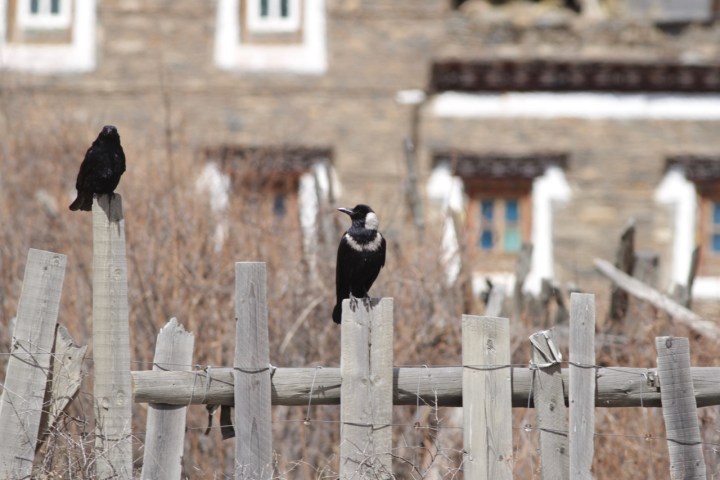
As I blogged before, on 2 April 2018 we were in a nature reserve, over 4,000 meter high, in Sichuan, China. As we went down gradually later that day, these two birds sat on a fence: a carrion crow on the left, and a collared crow on the right. Seconds later, the carrion crow drove its collared colleague away. Without any obvious reason, as there was space enough on the fence.

Daurian redstart, 2 April 2018

A bit further, this male Daurian redstart. ‘Daurian’ refers to the Dauria region, east of Lake Baikal in Russia.

Yaks, 2 April 2018

Near a farm and a river, these domestic yaks.

Up the mountain slope, a hoopoe.

Plumbeous water redstart, 2 April 2018

On rocks in the river, another redstart: a plumbeous water redstart. In western Europe are only two redstart species. In China there are fourteen. Songbirds originated in Australia, about 50 million years ago. So, one can expect…

View original post 154 more words

Fossil baleen whale discovery in New Zealand

petrel41's avatarDear Kitty. Some blog

This video says about itself:

36.4M-Year-Old Fossilized Skeleton May Be Oldest Baleen Whale Relative

12 May 2017

Whale fossil found in Peru is the oldest-known baleen whale relative ever discovered, according to research published May 11 in Current Biology.

From the University of Otago in New Zealand:

New genus and species of extinct baleen whale identified

April 18, 2018

University of Otago palaeontologists are rewriting the history of New Zealand’s ancient whales by describing a previously unknown genus of baleen whale, alive more than 27.5 million years ago and found in the Hakataramea Valley.

The new genus and species of extinct baleen whale is based on a skull and associated bones unearthed from the Kokoamu Greensand, a noted fossil-bearing rock unit in the South Canterbury and Waitaki district from the Oligocene period, which extends from about 33.9 million to 23 million years ago. At this time, New…

View original post 586 more words